A Strategic Guide for Modern Businesse – AMR Technosoft Private Limited
Introduction
In today’s fast-paced business environment, the way companies acquire and manage IT equipment has evolved dramatically. Gone are the days when purchasing hardware outright was the only option. A growing number of forward-thinking organisations — from startups to large enterprises — are choosing to rent their IT equipment instead of buying it, and for good reason.
Whether you need laptops, servers, networking gear, or specialised hardware, renting offers a compelling combination of financial flexibility, technological agility, and operational simplicity. This article explores the key reasons why renting IT equipment is often the smarter choice — and when buying might still make sense.
1. Financial Flexibility and Preserved Capital
One of the most immediate and tangible benefits of renting IT equipment is the impact on your cash flow. Purchasing hardware outright requires a significant upfront capital expenditure — money that could otherwise be invested in product development, marketing, hiring, or other growth initiatives.
Renting converts these large, unpredictable costs into predictable monthly payments. This shift from capital expenditure (CapEx) to operational expenditure (OpEx) brings several advantages:
- Predictable budgeting — fixed monthly costs make financial planning straightforward.
- Preserved working capital — funds remain available for core business priorities.
- Improved liquidity — businesses maintain a healthier balance sheet.
- Reduced financial risk — no large sunk cost if needs change suddenly.
For small and medium-sized enterprises (SMEs) especially, this financial breathing room can be the difference between stagnating and scaling.
2. Access to the Latest Technology
Technology evolves at a relentless pace. The laptop that was cutting-edge two years ago may already be struggling to run the latest software efficiently. When you purchase IT equipment, you lock yourself into that technology for its entire useful life — typically three to five years.
Renting removes this constraint entirely. At the end of a rental term, you simply return the equipment and upgrade to the latest models. This means your team is always working with modern, high-performance hardware — boosting productivity and maintaining a competitive edge.
Consider the implications for industries like graphic design, video production, data science, or software development, where processing power and hardware specifications directly impact output quality and turnaround time. Staying current with hardware is not a luxury — it is a necessity.
3. Reduced Maintenance Burden
Owning IT equipment means owning its problems. When a device malfunctions, breaks down, or reaches end-of-life, the cost and responsibility of repair or replacement falls squarely on the owning organisation. For companies without dedicated IT teams, this can be a significant distraction and expense.
Most IT rental agreements include comprehensive service packages that cover:
- Hardware maintenance and repairs.
- Replacement devices in the event of failure.
- Technical support and troubleshooting.
- Software licensing updates (in some packages).
This shifts the operational burden to the vendor, freeing your internal team to focus on strategic work rather than equipment troubleshooting. The result is less downtime, faster issue resolution, and a more productive workforce.
4. Scalability and Business Agility
Business needs are rarely static. A company may need to rapidly onboard a hundred new employees, equip a temporary project team, or scale back hardware during a restructuring. In each scenario, owning equipment creates friction and financial waste.
Renting offers unmatched scalability. Need 50 additional laptops for a six-month project? Rent them. Project ends? Return them. There is no surplus inventory to manage, no depreciated assets sitting idle, and no capital tied up in underutilised hardware.
This agility is particularly valuable for businesses in growth phases, seasonal industries, event-driven sectors, or organisations that rely on project-based workforce models. Renting aligns IT resources with actual business demand — a fundamental principle of efficient operations.
5. Tax Advantages
From a tax perspective, renting IT equipment is often more advantageous than purchasing. Rental payments are typically classified as operating expenses, which means they can be fully deducted in the year they are incurred — reducing taxable income immediately.
In contrast, purchased equipment must be capitalised and depreciated over its useful life — often three to five years — meaning the tax benefit is spread out and delayed. For businesses seeking to maximise current-year deductions, the rental model offers a clear fiscal advantage.
6. Simplified IT Asset Management
Managing a fleet of owned IT assets is a complex, ongoing undertaking. IT teams must track serial numbers, warranties, licensing agreements, maintenance schedules, and depreciation — all while juggling the demands of day-to-day operations.
Renting dramatically simplifies this burden. The vendor maintains asset records, manages warranties, and coordinates replacements. Your organisation receives a streamlined, up-to-date inventory without the administrative overhead. This allows IT departments to redirect their energy towards digital transformation, cybersecurity, and innovation — work that genuinely drives the business forward.
7. Environmentally Responsible Disposal
Electronic waste (e-waste) is one of the fastest-growing waste streams globally. Disposing of IT equipment responsibly requires compliance with environmental regulations, secure data destruction, and certified recycling processes — all of which come with significant complexity and potential cost.
When you rent, end-of-life disposal is the vendor’s responsibility. Reputable rental providers adhere to environmental standards and ensure that retired equipment is securely wiped and responsibly recycled or refurbished. This not only reduces your organisation’s environmental footprint but also shields you from regulatory risk.
For businesses with strong environmental, social, and governance (ESG) commitments, this aspect of the rental model is an increasingly important consideration.
8. When Buying Still Makes Sense
It would be misleading to suggest that renting is always the superior option. There are specific scenarios where purchasing IT equipment remains the more practical choice:
- Long-term stability: If the same equipment will be used for five or more years without change, the total cost of ownership may favour purchasing.
- Highly specialised hardware: Custom or niche equipment may not be readily available through rental vendors.
- Large, established IT teams: Organisations with robust in-house IT capabilities may manage assets more efficiently than a vendor could.
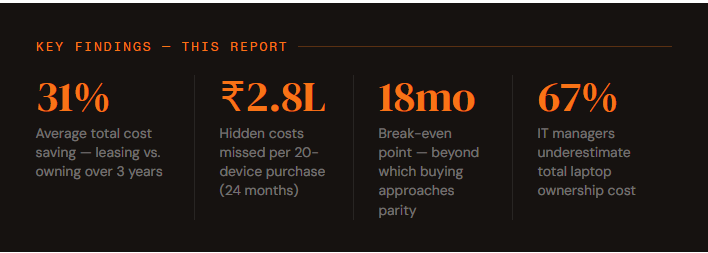
- Full cost analysis: For certain hardware categories, a detailed total cost of ownership (TCO) analysis may reveal that purchasing is more cost-effective over the long term.
The right decision depends on your organisation’s size, growth trajectory, technology requirements, and financial strategy. In many cases, a hybrid approach — renting some categories of equipment while owning others — may yield the best outcome.
Conclusion
The case for renting IT equipment has never been stronger. In an era defined by rapid technological change, economic uncertainty, and the need for operational agility, the flexibility and financial efficiency of renting offers clear advantages over the traditional purchase model.
By choosing to rent, businesses can preserve capital, stay current with technology, reduce administrative overhead, scale with demand, and operate with greater environmental responsibility — all while maintaining the financial predictability that modern organisations require.
If your business has not yet considered IT rental as a strategic option, now is the time to explore it. The benefits are real, measurable, and increasingly essential for organisations that want to remain competitive in a fast-moving world.